
R. L. Dabney
14 articles · 7 topics
Robert Lewis Dabney (1820–1898) was the most rigorous systematic theologian the Southern Presbyterian tradition produced, and a figure of genuine intellectual stature whose theological legacy far outlasted the political controversies that surrounded his life. Born in Louisa County, Virginia, he studied at Hampden-Sydney College and Union Theological Seminary in Virginia before embarking on a pastoral ministry that was interrupted by the Civil War.
During the war, Dabney served as chief of staff and adjutant general to Stonewall Jackson — a personal friend — and wrote a biography of Jackson after the general's death that remains a standard source. After the war, he returned to Union Theological Seminary, where he taught systematic theology until 1883, then moved to the newly founded University of Texas, where he taught philosophy until advancing blindness ended his academic career.
His Systematic Theology (originally published as Lectures in Systematic Theology) is the most thorough and rigorous work of systematic theology produced within the Southern Presbyterian tradition — deeply Reformed, closely argued, and drawing on a vast range of theological sources. His five-volume Discussions cover every major area of theology, ecclesiology, philosophy, and social questions. Dabney was also deeply controversial — his defenses of the Confederacy, his opposition to the reunion of Northern and Southern Presbyterians, and his views on race have rightly been criticized. But even those who reject his social views have recognized the power and precision of his theological mind.
Books by R. L. Dabney
4 books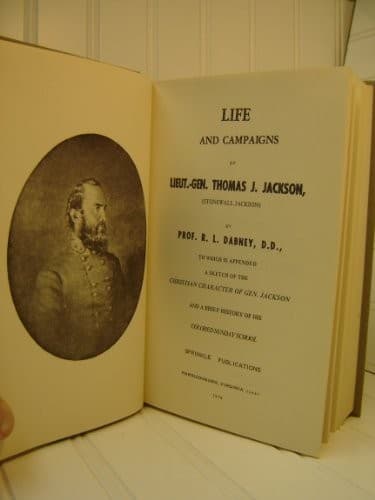
Grace Online Library is an Amazon Associate. Purchases made through these links help support the library at no extra cost to you.
Read Articles by R. L. Dabney
The Five Points of Calvinism - Part 1
Introduction: Historically, this title is of little accuracy or worth; I use it to denote certain points of doctrine, because custom has made it familiar. Early in the seventeenth century the Presbyterian Church of Holland, whose doctrinal confession is the same in substance with ours, was much…
The Five Points of Calvinism - Part 2
II. The Nature and Agency of the Moral Revolution, Named Effectual Calling or Regeneration. This change must be more than an outer reformation of conduct, an inward revolution of first principles which regulate conduct. It must go deeper than a change of purpose as to sin and godliness; it must be…
The Five Points of Calvinism - Part 3
III. God's Election. In our Confession, Chapter III., Section iii., verses 4 and 7, we have this description of it: 3d. 'By the decree of God, for the manifestation of his glory, some men and angels are predestined unto everlasting life and others foreordained to everlasting death.' IV. 'These…
The Five Points of Calvinism - Part 4
IV. Particular Redemption. 'Did Christ die for the elect only, or for all men?' The answer has been much prejudiced by ambiguous terms, such as particular atonement, limited atonement; or general atonement, unlimited atonement, indefinite atonement. What do they mean by atonement? The word…
The Five Points of Calvinism - Part 5
V. Perserverence of the Saints. Our Confession, in Chapter XVII., Sections i and ii., states this doctrine thus: 'They whom God hath accepted in his beloved, effectually called and sanctified by his Spirit, can neither totally nor finally fall away from the state of grace, but shall certainly…
Arminian Theory of Redemption - Part I (Lecture 48)
THE subjects which are now brought under discussion introduce us to the very center of the points which are debated between us and Arminians. I propose, therefore, for their further illustration, and because no better occasion offers, to consider here their scheme. Sources of the Arminian Theology…
Arminian Theory of Redemption - Part II (Lecture 49)
Conditional Decrees are Implied in Synergism THE favorite Arminian dogma, that God's will concerning the salvation of individuals is conditioned on His simple foresight of their improvement of their common grace, in genuine faith, repentance, and holy obedience, is necessary to the coherency of…
Divine Attributes: Part I
Traditionary knowledge not to be separated from rational, here. It is exceedingly hard for us to return an exact answer to the question, How much reason can infer of the attributes of God? Shall we say: 'So much as the wisest pagans, like Plato, discovered of them?' It still remains doubtful how…
Divine Attributes: Part II
When we enquire after God's power we mean here, not his potestas, or exousia, authority, but His potentia, or dunamis. When we say: He can do all things, we do not mean that He can suffer, or be changed, or be hurt; for the passive capacity of these things is not power, but weakness or defect. We…
Free Agency and the Will
1. Man a free agent, denied by two parties BUT is man a free agent? Many have denied it. These may be ranked under two classes, Theological Fatalists and Sensualistic Necessitarians. The former argue from the doctrine of God's foreknowledge and providence; the latter from the certainty, or, as it…
Free Agency and the Will -
1. Man a free agent, denied by two parties BUT is man a free agent? Many have denied it. These may be ranked under two classes, Theological Fatalists and Sensualistic Necessitarians. The former argue from the doctrine of God's foreknowledge and providence; the latter from the certainty, or, as it…