
John Owen
12 articles · 5 topics
John Owen (1616–1683) is without question the greatest English Puritan theologian, and many would rank him among the most important theological minds in the history of Reformed Christianity. Born in Stadhampton, Oxfordshire, the son of a Puritan minister, he was educated at Queen's College, Oxford, and spent the first years of his ministry struggling with assurance of salvation — an experience that gave his subsequent theology an unusually deep and pastoral character.
His conversion to firm Calvinist convictions, his rise to prominence as a preacher, his friendship with Oliver Cromwell, and his appointment as Vice-Chancellor of Oxford all came in quick succession in the 1640s and 1650s. As Cromwell's chaplain, Owen preached to Parliament on the day after the execution of Charles I. As Vice-Chancellor, he presided over a university that briefly became the most tolerant institution of higher learning in England. With the Restoration in 1660, he lost all his positions and spent the rest of his life as a Nonconformist minister in London, ejected, occasionally harassed, but never silenced.
The range and depth of Owen's works is staggering. His seven-volume commentary on Hebrews is the most thorough ever written. His treatise On the Mortification of Sin in Believers has guided Christians in the fight against sin for three and a half centuries. Communion with God, The Glory of Christ, and Of the Holy Spirit together constitute the most comprehensive Puritan treatment of Trinitarian devotion and theology. His Salus Electorum, Sanguis Jesu — known as The Death of Death in the Death of Christ — remains the definitive Reformed defense of particular atonement. Owen wrote slowly, densely, and with enormous theological precision; C. H. Spurgeon said that if you could understand Owen, you could understand anything.
Books by John Owen
44 books
Sermons from the Early Restoration Years, 1669-1675 (Volume 20, The Complete Works of John Owen)
2026
Sermons and Tracts from the Civil Wars, 1646-1649 (Volume 18, The Complete Works of John Owen)
2025
Sermons from the Commonwealth and Protectorate, 1650-1659 (Volume 19, The Complete Works of John Owen)
2025
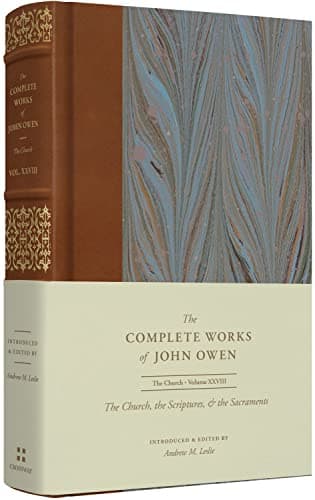
The Church, the Scriptures, and the Sacraments (Volume 28, The Complete Works of John Owen)
2024
Grace Online Library is an Amazon Associate. Purchases made through these links help support the library at no extra cost to you.
Read Articles by John Owen
Evidences of the faith of God’s Elect – Introduction
The securing of the spiritual comforts of believers in this life is a matter of the highest importance unto the glory of God, and their own advantage by the gospel. For God is abundantly willing that all the heirs of promise should receive strong consolation, and he has provided ways and means for…
Evidences of the faith of God’s Elect – Part I
How does saving faith approve of this way? on what accounts, and unto what ends? First, It approves of it, as that which every way becomes God to find out, to grant, and propose: so speaks the apostle, Heb.2:10, 'It became him, in bringing many sons unto glory, to make the Captain of their…
Evidences of the faith of God’s Elect – Part II
The second evidence of the faith of God's elect The second way whereby true faith does evidence itself in the souls and consciences of believers, unto their supportment and comfort under all their conflicts with sin, in all their trials and temptations, is by a constant approbation of the…
Evidences of the faith of God’s Elect – Part III
The third evidence of the faith of God's elect Thirdly, Faith will evidence itself by a diligent, constant endeavour to keep itself and all grace in due exercise in all ordinances of divine worship, private and public. This is the touchstone of faith and spiritual obedience, the most intimate and…
Evidences of the faith of God’s Elect – Part IV
The fourth evidence of the faith of God's elect I come, in the next place, to instance in a peculiar way whereby true faith will evidence itself,--not always, but on some occasions: and this is by bringing the soul into a state of repentance. And three things must be spoken unto,-- In general, what…
Evidences of the Faith of God’s Elect – Preface
Prefatory Note This treatise, entitled Gospel Grounds and Evidences of the Faith of God's Elect,' was given to the world in 1695. The remainder of the title is scarcely applicable as a correct designation of the leading divisions of the work. and may, perhaps, have been added by those who had the…
The Grace and Duty of Being Spiritually Minded - Part I
Excerpted from The Grace and Duty of Being Spiritually Minded (1681), chapter XI. William H. Goold, the nineteenth-century editor of Owen's Works, wrote concerning this treatise: 'There is scarcely one of the more important works of Owen, but some authority might be quoted as signifying a…
The Grace and Duty of Being Spiritually Minded – Part II
2. He hath done the same in his dealings with the apostles, and generally with all that have been most dear unto him and instrumental unto the interest of his glory in the world, especially since life and immortality were brought to light by the gospel. He had great work to do by the apostles, and…
The Grace and Duty of Being Spiritually Minded – Part III
It may be said, that 'if it be so difficult to distinguish between these things, — namely, the lawful use of things here below and their abuse, the allowable industry about them and the inordinate love of them, — on the knowledge whereof our eternal condition depends, it is impossible but men must…